Quantum computing is no longer a distant idea confined to physics journals. Inside a lab on the outskirts of Paris, a quiet yet intense effort is underway to reshape how problems are solved across industries.
The setting may appear technical—filled with gleaming cylinders, wires, and ultra-cold chambers—but the ambition behind it is clear: build machines powerful enough to tackle challenges that today’s computers simply cannot handle.
At the center of this effort stands a growing European ecosystem, with France emerging as a serious contender in the global race.
Inside a Quantum Lab
In one corner of the lab, a technician named Rémi adjusts a complex device using a simple spanner. The machine in front of him is called a cryostat—a structure made of stacked gold and silver cylinders, connected by dense wiring. Its purpose is highly specific: to create an environment colder than almost anywhere else on Earth.
At its lowest point, temperatures drop to –273°C, close to absolute zero. Under these conditions, thermal vibrations fade, and external interference disappears. This extreme isolation allows scientists to observe delicate quantum behavior.
Inside this system sits a small chip, housed in a metallic casing. Within that chip, subatomic particles behave in ways first explored by Albert Einstein and other pioneers. These particles can jump between energy states in precise yet counterintuitive ways—a phenomenon often referred to as the “quantum leap.”
The machines powering this research have a more familiar name: quantum computers.
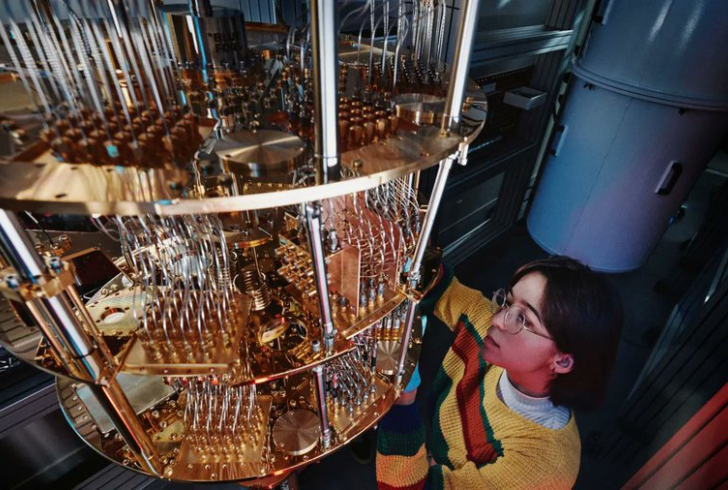
X | Carlos Creus Moreira | By chilling a cryostat to near absolute zero, Rémi creates the perfect silence for quantum observation.
How Quantum Computing Works
Traditional computers rely on silicon chips and electrical signals processed in binary form. Quantum systems operate differently. Instead of bits, they use qubits.
Qubits rely on quantum behavior in particles like electrons or photons. These states allow information to exist in multiple forms at once, which opens up new ways of computing.
The challenge lies in stability. Qubits are extremely sensitive to environmental noise. Even slight interference can disrupt their state, a process known as decoherence.
To manage this, many systems use large numbers of physical qubits to create a single stable “logical” qubit. This approach often requires massive hardware and complex error correction methods.
Alice & Bob and a Different Design Path
In France, a company named Alice & Bob is taking a different direction. The team, roughly 200 people strong, includes physicists and engineers working on alternative qubit designs.
Co-founder and CEO Théau Peronnin describes a shift in scientific belief:
“Physicists used to doubt it was possible to leverage the weird behavior of particles in the quantum. They don’t anymore.”
He adds another key point about future capability:
“Now we know they work, and in a few years we will have reliable quantum computers that we can hook up to High Performance Computers in data centers to exponentially increase their computing power.”
The focus is not simply speed. It is about expanding what computation can realistically solve.
Peronnin explains it clearly:
“It’s not about being faster. It’s about being so dramatically faster that you change what is feasible.”
One example often mentioned is medicine. Instead of relying heavily on trial and error, quantum systems could simulate molecular interactions in detail.
“New medicines are largely a question of trial and error,” he notes. With quantum computing, molecular behavior could be modeled before physical testing begins.
The Fragility Problem and a New Approach
At the core of quantum computing is a major technical hurdle: fragility. Qubits lose their quantum state quickly due to external disturbance.
Most companies handle this using redundancy, where thousands of physical qubits support one logical qubit. While effective, it increases size and cost significantly.
Alice & Bob takes another route using “cat qubits,” named after the Schrödinger’s cat thought experiment. These qubits are designed to correct some errors automatically.
Peronnin explains:
“It’s built-in by design. We cracked a way to compensate for losses continuously.”
This design reduces reliance on large error-correction systems, aiming for simpler scaling in the long term.
The company has also developed a chip called “Boson,” marking progress in hardware development. Around the industry, similar ideas are gaining attention. Google’s acquisition of Atlantic Quantum reflects this growing interest in alternative qubit approaches.
Europe’s Growing Quantum Network
Across France alone, quantum computing is no longer a single-company effort. Six major companies operate in the country, with two more emerging. Among them are Pasqal, Quandela, Quobly, and C12, each exploring different qubit technologies.
Tech analyst Olivier Ezratty notes that France holds a structural advantage in this field. Many systems show strong energy efficiency and lower operating cost compared to early prototypes elsewhere.
Elsewhere in Europe, Finland’s IQM has become a major player and announced plans to go public, marking a milestone for European quantum firms.
In the United Kingdom, Oxford Quantum Circuits (OQM) focuses on hardware development, while Riverlane builds operating systems for quantum machines.
Some systems are already running in real environments. Companies like Air Liquide have started using quantum computers within industrial settings, showing early integration into high-performance computing networks.
These machines are still early-stage tools. Peronnin compares current capability to basic devices, saying:
“At the moment, the machine we have is no more powerful than your telephone.”
However, their value lies in preparation. Early deployment helps engineers and researchers build expertise before full-scale systems arrive.
Several French quantum machines already operate in industrial environments, creating practical experience for future expansion.
Education, Talent, and Scientific Strength
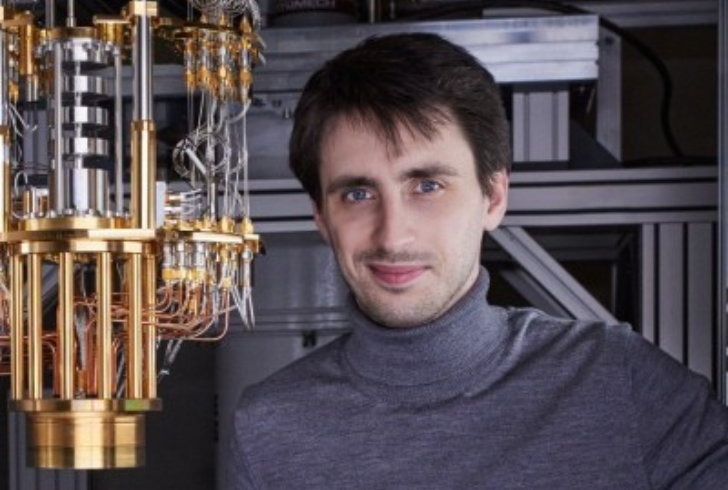
LinkedIn | Led by Théau Peronnin, Alice & Bob is building the “impossible” quantum future.
France holds a strong position in quantum research due to its academic institutions, including École Polytechnique and École Normale Supérieure. These schools produce many of the researchers entering the field.
Recent scientific recognition also supports this base. Three Nobel Prizes have gone to French physicists in recent years, reinforcing the country’s role in advanced physics research.
Peronnin points out that the field remains balanced globally:
“At the end of the day, it’s a math challenge. There is no unfair advantage from legacy technology.”
This makes expertise and funding the main deciding factors.
Investment Pressure and Global Competition
Building quantum systems requires large financial backing. Europe holds the resources, but coordination and investment scale remain key challenges.
Peronnin sees potential in this moment:
“Europe is definitely not poor and this is a technological opportunity to reshape autonomy and economic leadership.”
He also notes a cultural shift needed in confidence and execution. Without stronger commitment, progress could slow despite technical strength.
The global race includes companies from the United States, China, and Europe, all working toward similar breakthroughs. The competition is open, with no clear long-term winner yet.
Quantum computing is steadily shifting from lab experiments into early-stage industrial applications, with Europe actively shaping its direction. France has developed a strong ecosystem supported by startups, research institutions, and government initiatives like PROQCIMA.
From advanced cryogenic labs in Paris to real-world industrial testing, development is progressing step by step. Key challenges remain around stability, cost, and scaling, though innovations such as cat qubits are opening new technical paths.
The future of this field will depend on continued research, investment, and real-world deployment. Europe is well positioned, and the next phase will decide how far this opportunity can go.