When law enforcement hunts for digital evidence, most people picture forensic analysts scanning hard drives in labs. Few imagine a black Labrador retriever leading the charge. Yet for more than a decade, one dog reshaped how federal investigations uncovered hidden technology.
FBI Special Agent Iris, a three-legged Labrador, became the bureau’s first electronics detection canine. Her nose located laptops, microSD cards, thumb drives, and buried cell phone parts that human teams missed.
Over time, her work sparked a formal training program and changed digital forensics inside the Federal Bureau of Investigation.
The Case That Proved It Worked
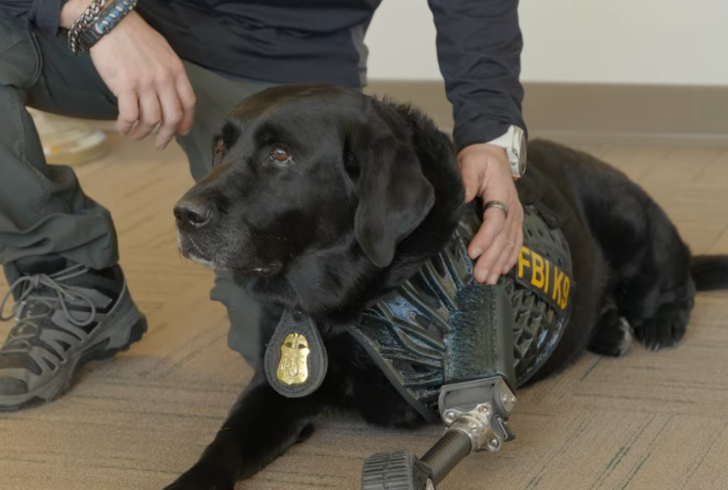
YouTube | PCMag | Special Agent Iris revolutionized FBI searches by detecting digital media invisible to human eyes.
On September 17, 2016, a bomb exploded in the Chelsea neighborhood of New York City. The blast launched a dumpster 120 feet, shattered windows, and injured 30 people. Authorities later identified Ahmad Rahimi as the man behind nine explosive devices placed across the region.
To secure evidence, the FBI obtained a warrant to search Rahimi’s home. That search introduced Iris to one of the most important investigations of her career.
At just one year old, Iris entered the residence with her handler, Special Agent Jeff Calandra. She began scanning rooms and quickly fixated on a closet. When called away, she refused. Inside a hidden compartment sat a concealed laptop.
Her discoveries extended beyond the hidden laptop. Iris pinpointed a thumb drive concealed inside a jar filled with pennies and later alerted to a detonated cellphone motherboard buried in the backyard.
That motherboard later appeared in court as key evidence tied to Rahimi’s explosive experiments. A federal jury sentenced him to life in prison.
After that case, internal skepticism faded. Requests for the electronics detection dog increased rapidly.
Building a New Forensic Tool
The concept of a dog trained to detect electronics was unconventional in 2014 when Calandra proposed it to supervisors in Newark. At the time, he worked on child exploitation cases and saw how often investigators overlooked hidden storage devices.
The proposal secured approval and a $20,000 budget. It was modest by federal standards but enough to test the idea.
Chemists at the FBI laboratory in Quantico helped identify materials in electronic devices that dogs could detect. The primary compound was triphenylphosphine oxide (TPPO), commonly used in circuit boards. However, detection dogs do not rely on one single odor. They learn to recognize a scent profile created by several chemical components.
Calandra connected with the Connecticut State Police, which had launched the first electronics detection canine, Selma, in 2013. From that program came Iris, a small black Lab selected for her intense food drive and focus.
Why Labradors Excel
Labradors are the top choice for electronics detection work because they are highly motivated by food rewards, which keeps their performance steady and focused. They also build strong working relationships with their handlers, making communication in the field clear and efficient. In addition, their powerful noses—equipped with an estimated 150 to 300 million scent receptors.
Humans, by comparison, have roughly five million. Dogs also dedicate nearly 30% of their brains to scent processing, while humans devote about 5%. Their nostrils function independently, allowing precise scent tracking. They can inhale and exhale simultaneously when sniffing, maintaining a steady chemical read of the air.
When Iris detected electronics, she signaled by sitting and holding a position. A confirmed find meant a food reward. Over time, she refined her signals, ignoring obvious items like mounted televisions and focusing on hidden devices more likely tied to evidence.
High-Stakes Testing at a Federal Level
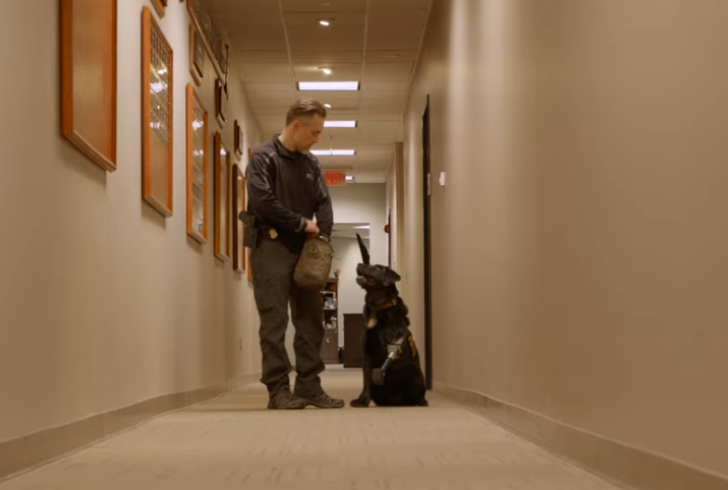
YouTube | PCMag | In 2016, Iris and Calandra flew to a camera-filled hangar for a 14-day government capability assessment.
In 2016, an unnamed government agency requested a rigorous evaluation of Iris’s capabilities. She and Calandra were flown by private jet to a large airport hangar lined with GoPro cameras. For two weeks, Iris completed complex search scenarios.
One test involved a stack of wooden pallets believed to contain no electronics. Iris circled the pile, then physically pushed it aside before sitting. A hidden device had been concealed beneath.
At the conclusion of testing, officials revealed she had located every single one of the 56 planted items.
That validation silenced doubts and reinforced her reliability at the highest operational levels.
Global Deployments and Major Cases
Within her first year, Iris traveled internationally, often sharing cramped economy seating with her handler. Calandra accepted nearly every request from local agencies and FBI field offices, working to prove the program’s long-term value.
Over the course of 11 years, the team carried out 2,000 searches and recovered nearly 20,000 electronic storage devices. The discoveries ranged from thumb drives and microSD cards to laptops and cell phones, many of which had been carefully concealed.
In 2018, Iris contributed to the arrest of Kevin Mallory, a former CIA officer who removed classified documents from headquarters in Langley, Virginia. Mallory stored secrets on microSD cards and attempted to sell them to China. Iris located the hidden devices. He received a 20-year prison sentence.
Calandra later described the effort as similar to being “a traveling salesman,” constantly demonstrating Iris’s effectiveness to leadership across agencies.
Experts such as Dr. Clara Wilson at the University of Pennsylvania PennVet Working Dog Center study canine scent detection, including dogs trained to identify diseases like cancer. Research confirms that scent work stimulates dogs mentally, comparable to humans reading or watching television.
To maintain drive, Iris was kept slightly hungry during searches. However, researchers note that many Labradors remain highly motivated regardless of feeding schedules.
Injuries, Risks, and Resilience
Iris’s career involved real danger. During one undisclosed case, she suffered electrocution. On two separate deployments, she encountered fentanyl exposure and required Narcan to reverse its effects.
In March 2025, she received a bone cancer diagnosis. Surgeons amputated her left front leg. A 3D-printed prosthetic replaced it, and she retired from service soon after.
Her retirement marked the close of a pioneering chapter. It also marked the beginning of a formal FBI electronics detection canine program. A new black Lab named Nyx entered training as her successor.
A Rare Look Inside FBI Operations
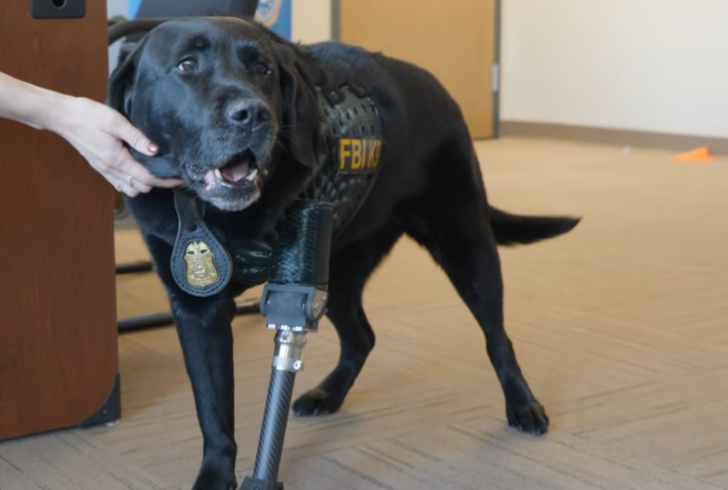
YouTube | PCMag | Iris showed that manual detection remains essential for retrieving hidden digital evidence.
A visit to the FBI’s downtown Newark headquarters along the Passaic River offered a rare view of the program. Security mirrored airport procedures. No smartphones, Wi-Fi devices, or Bluetooth equipment were permitted.
On the 12th floor, Iris appeared wearing an official credential badge and a custom “FBI Iris K9” sweatshirt branding. Even in retirement, she remained energetic, greeting visitors enthusiastically before settling calmly at their feet.
Calandra, now 46, once admitted that early in the process, he had minimal dog-training experience beyond owning a Yorkie. Over time, partnership and repetition built precision.
Legacy in Digital Forensics
Over the course of her career, Iris demonstrated that modern digital investigations could benefit from a surprisingly analog approach. Criminals often depend on encrypted drives and tiny storage devices that vanish into everyday spaces. A flash drive hidden inside a wall cavity, buried in the ground, or tucked inside an ordinary jar can easily evade human searches.
Her track record made something clear: scent detection could dramatically improve how quickly investigators located digital evidence. The time that once vanished in long manual searches could be cut down significantly.
The FBI later developed a formal program to train electronics detection dogs, building on the success of Iris’s work. What started as a small experimental idea with limited funding gradually proved its value and became a trusted investigative resource in major cases.
FBI Special Agent Iris left a mark that went well beyond locating devices. Her work influenced how federal teams plan and conduct digital evidence searches. From the Chelsea bombing case to sensitive counterintelligence investigations overseas, the strategy she helped introduce became part of the playbook.
Her career sat at the intersection of behavioral science, careful training, and raw instinct. As storage technology shrinks and digital evidence becomes easier to hide, the approach she helped establish continues to guide investigators looking for data that refuses to stay visible.